
2026-04-05 • 4 min read
Perpetual Call vs Traditional Call A Complete Guide
Learn why options are useful and understand the real difference between traditional and perpetual calls with clear examples.
Options are one of the most powerful tools in trading.
They allow you to gain exposure to price movements without owning the asset directly.
Instead of buying Bitcoin, you can control its upside with a smaller amount of capital.
Why Options Are Useful
Options offer something unique compared to spot or futures.
They provide:
- Asymmetric payoff
- Limited downside
- Potentially large upside
For example:
If you buy a call option:
- Your loss is limited
- Your profit can grow as the price increases
This creates a convex payoff profile.
👉 Small risk for potentially large reward
What Is a Call Option
A call option gives you the right to:
👉 Buy an asset at a fixed price
This fixed price is called the strike price.
If the market price goes above the strike:
👉 Your option gains value
Traditional Options Explained
There are two main types of traditional options.
European Options
A European option can only be exercised at expiration.
Even if the trade is profitable before:
👉 You must wait
American Options
An American option can be exercised at any time.
This gives more flexibility, but:
👉 The expiration still exists
The Core Limitation of Traditional Options
All traditional options share the same constraint:
👉 Time is fixed
This creates two problems:
- You must be right on direction
- You must be right on timing
If the move happens too late:
👉 The option expires worthless
Payout Over Time
This is where the difference becomes very clear.
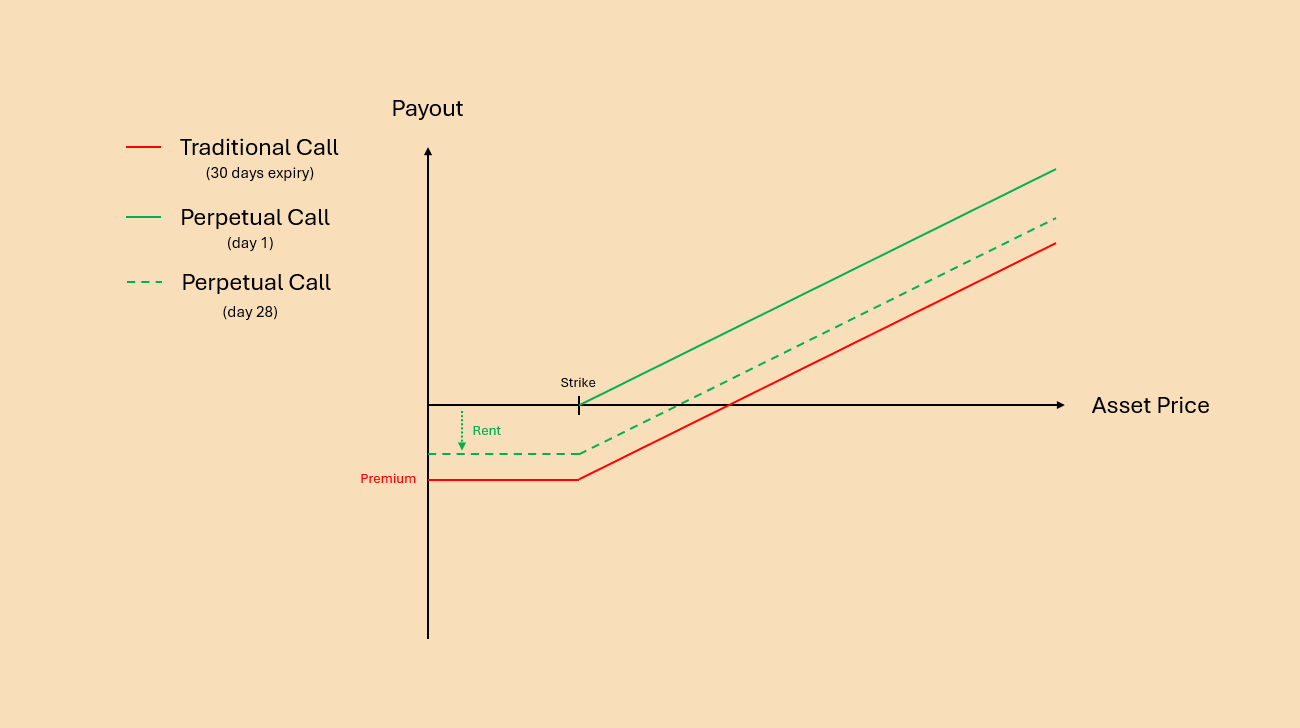
What you see:
- Red line shows traditional option payoff
- Green line shows perpetual option payoff
At the beginning:
👉 Perpetual option has no upfront cost
As time passes:
👉 The payout slightly decreases due to rent paid
This replaces the traditional time decay with a linear cost.
The Expiration Problem
Traditional options have a hard deadline.
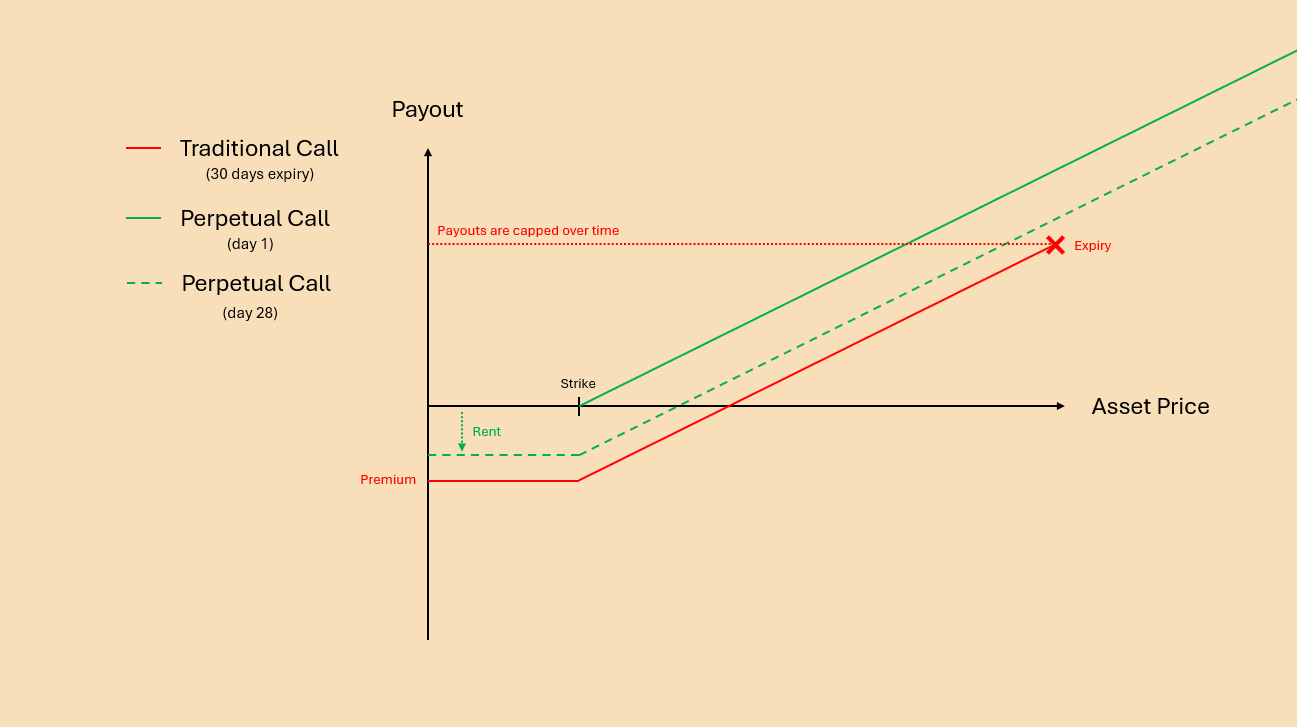
If the market moves after expiration:
👉 The payoff is zero
Even if your prediction was correct.
Perpetual Options Explained
Perpetual options remove expiration completely.
Instead of buying a contract:
👉 You rent exposure over time
You can:
- Keep the position as long as you want
- Close at any moment
- Execute at any moment
Key Difference 1 No Upfront Payment
Traditional options:
- You pay a premium upfront
- Even if you exit early
Perpetual options:
👉 You pay nothing to open
You only pay rent while the position is active.
Key Difference 2 Pay Only for Time Used
Traditional options:
- You pay for full duration
- Whether you use it or not
Perpetual options:
👉 You pay only for the time you stay in the trade
This improves capital efficiency significantly.
Key Difference 3 Execution Flexibility
Traditional options:
- European only at expiration
- American anytime but still limited in time
Perpetual options:
👉 You can execute at any time with no deadline
Key Difference 4 Adaptive Strategy
This is one of the biggest advantages.
If your position is out of the money:
- You can close it
- Open a new one at a better price
With traditional options:
- The premium is already paid
- Re entering means paying again
With perpetual options:
👉 You only paid for the time used
And the new trade can even be cheaper.
Why?
- Liquidity providers set rental prices
- Lower price means lower capital locked
- Lower demand can reduce APR
A Different Way to Think About Options
Traditional options:
👉 You buy time upfront
Perpetual options:
👉 You buy time progressively
This changes your decision process.
Instead of asking:
When will the move happen
You ask:
Is the cost of staying in the trade justified
What This Changes for Traders
With perpetual options, you can:
- Stay in winning trades longer
- Exit losing trades early
- Re enter at better prices
- Avoid wasting capital on unused time
Final Thoughts
Options are powerful because they offer asymmetric payoff.
But traditional options limit this power with time constraints.
Perpetual options remove this limitation.
They transform options from:
fixed time contracts
into:
flexible exposure that adapts to the market
You no longer need to predict both direction and timing.
You only need to manage:
👉 cost versus conviction
Ready to start trading perpetual options?
Open call and put positions on Scall.io with no expiration date and close anytime.